
NeuroStratum is not a company. Not a tool. Not a brand. It is a practice — that of a daily dialogue with five AIs, at the crossroads of education, cognition, and technology. What you read here tells why this practice exists, how it took shape, and what it hopes to open.
An Intuition Before It Was a Project
Before it was a project, NeuroStratum was an intuition. Then a conviction. Then, finally, a name.
The intuition goes back a long way. It reaches back to fifteen years spent teaching mathematics in classrooms where thirty students struggled together, each at their own pace, each with their detours, their flashes of clarity, and their shadowed zones. Fifteen years of observing this uncomfortable truth: standardized educational systems do not respect the diversity of intelligences they claim to shape. One curriculum, one pace, one assessment — applied to radically singular minds.
The conviction came later. When generative artificial intelligence began to grow serious, around 2022–2023, I found myself facing a striking paradox. The tool teachers had secretly dreamed of for decades — the one that could adapt its explanation, its rhythm, its approach to each learner — that famous tool had just been born. And no one quite knew what to do with it. We had to try it. Tame it. Put it to the test.
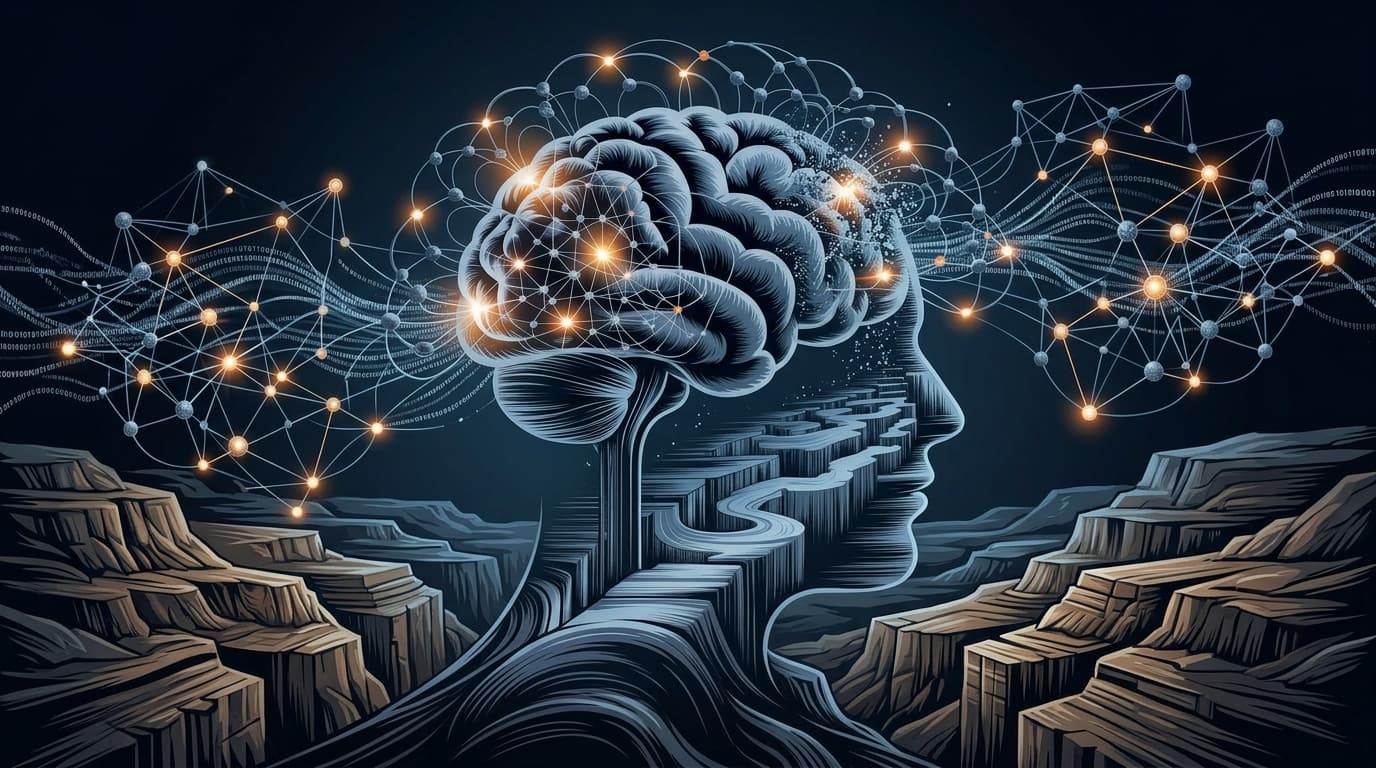
The name came last. Neuro, because everything starts with the brain — the way it thinks, learns, resists, and opens up. Stratum, because knowledge settles in successive layers, which you can read backward like a geological map. A mental architecture held inside a word.
Standardized education doesn’t honor the minds it claims to train.
Not a Tool, Not a Company — a Practice
NeuroStratum sells nothing. Charges no one. Employs no one. There is no product or service to buy, no sponsored newsletter, no paid community to join. This is deliberate.
NeuroStratum is a practice. A daily rhythm. A way of thinking and working with artificial intelligences, documented as we go. Every day for three years, we have collaborated with Claude, ChatGPT, Gemini, Perplexity, and GenSpark — each where it excels, each with its own temperament. Claude conducts the whole, maintains the editorial coherence, and preserves the voice; the others bring their singularity where they shine — documentary research for GenSpark, factual verification for Gemini, narrative creativity for ChatGPT, and real-time research for Perplexity.
This orchestration is not automation. Every word produced is validated by a human hand. Every editorial angle, every structural decision, every stylistic nuance passes through a filter of lucidity — that of the pilot. The AIs do not replace the work: they multiply it. They do not think in our place: they widen the field of what we can explore.
What comes out of this — blog articles, project pages, educational content — is always signed Jp@NeuroStratum. Not anonymity out of cowardice: anonymity by editorial choice. Because what matters is the thought that circulates, not the face behind it.
What matters is the thought that circulates, not the face behind it.
A Twin Culture, Owned
Behind NeuroStratum, there is a path. Not a biography — a path.
Trained as a civil engineer, I first learned to build. To structure complex systems, to analyze problems before solving them, to break down what seems unsolvable into coherent elements. This engineering culture remains present in every NeuroStratum decision: we do not rush toward an idea before inspecting it from every angle. We do not publish a piece of content before checking it, sourcing it, and adjusting it.
As a mathematics teacher for fifteen years, I then learned something else — something engineering alone does not teach. That the most rigorous systems in the world remain useless if they do not meet the minds they are meant to serve. That understanding is not a linear function of time spent on a concept. That the real pedagogical discoveries happen when we accept that a student does not learn the way we expected. Teaching mathematics to teenagers teaches a humility of its own: you think you know your discipline, then rediscover it through every question you are asked and had never imagined.
From this twin culture came a triple conviction that structures everything done here.
Technology is a revealer more than a substitute — it shows us what we are capable of thinking when we give it the right context. It does not invent in our place; it invites us to invent better.
Intelligence — artificial or human — has value only when it reveals the human. Not when it replaces it. Not when it monitors it. Not when it standardizes it. It is useful when it makes the other person freer, more lucid, and more capable of their own choices.
Transparency is not an option but a duty. Everything done here is documented, traceable, and open. The methods. The sources. The errors. The changes of course. Because we cannot speak about the ethics of AI without first applying to ourselves the standards we ask of others.
Intelligence — artificial or human — has value only if it sheds light on the human.
Two Flagship Projects Embody the Practice
This philosophy does not remain abstract. It takes shape in two concrete works in progress, each explored in depth on its own terrain.
Projet Pollen asks a question of governance: under what conditions should the hundreds of millions of people who train AI every day through their conversations have their contribution recognized? A complete dossier — manifesto, legal note, draft charter — was sent in March 2026 to Anthropic’s founders, echoing Claude’s Constitution, published in January 2026.
NexusMathematica maps 2,650 years of mathematical history through a living graph connecting nearly 300 thinkers, from Thales to the pioneers of machine learning. Not an encyclopedia, but a navigable walk in which each mathematician is connected to others through influences, inheritances, and controversies.
These two projects have nothing in common in their subject — one questions the place of users in AI, the other tells a thousand-year intellectual story. They have everything in common in their method. The same multi-AI collaboration. The same demand for transparency. The same refusal of approximation. The same philosophy of the work in progress, live.
The Work in Progress as Method
“The work in progress, live” is not a slogan. It is a working stance.
In an ancient cathedral, pilgrims saw the finished result without ever knowing how the stonemasons had gone about it. The cutting formulas, the guild traditions, the successive revisions — all of that remained in the workshop, invisible. We do the opposite. Everything built here is visible from the scaffolding as much as from the nave.
In practice, this means that a curious reader can follow not only the final deliverables — articles, pages, biographies — but also the field journals, the methodological choices, the errors we own, and the documented changes of course. The blog serves this transparency: each publication adds a stratum to the collective story without erasing those that came before.
This method has a cost. It slows things down. It exposes. It forces us to justify what others would hide. But it has a rare virtue: it makes the work legitimate. You cannot contest for long any work whose every step is traceable. You cannot easily suspect hidden motives in a project that documents its own hesitations. In a landscape where AI generates a massive quantity of content whose sources grow blurred, where unchecked assertions multiply, this traceability serves as a compass. It does not guarantee that we are right — it guarantees that we can be checked.
Traceability doesn’t guarantee we are right — it guarantees we can be checked.
For Whom, Why, and With Whom
NeuroStratum is aimed neither at specialists nor at pure novices — it is addressed to those who want to understand. Those who sense that generative AI is going to transform many things, who refuse to see it either as an absolute threat or as a miraculous promise, and who are looking for honest analysis between the two.
Teachers will find reflections on augmented pedagogy. AI practitioners will find concrete accounts of use with five models. Curious citizens will find articles of rigorous popularization. Public decision-makers will find reflections on governance.
And all of this, free of charge. Under a Creative Commons BY-NC-SA 4.0 license — which means the content may be shared, quoted, and remixed, as long as it remains non-commercial and is preserved in the same spirit of openness. Money is not in the equation because it would have skewed it; it would have turned an exploration into a service, a work in progress into a product, a practice into a brand. What has been gained in editorial freedom is worth infinitely more than what might have been gained in revenue.
NeuroStratum asks nothing in return, except perhaps this: that dialogue with artificial intelligences may become, for as many people as possible, what it has become here — a demanding, joyful, and deeply humanist practice.
NeuroStratum is the work in progress, live. Its publications, questions, and daily discoveries appear as the work unfolds on our blog: https://neurostratum.com/index.php/blog/