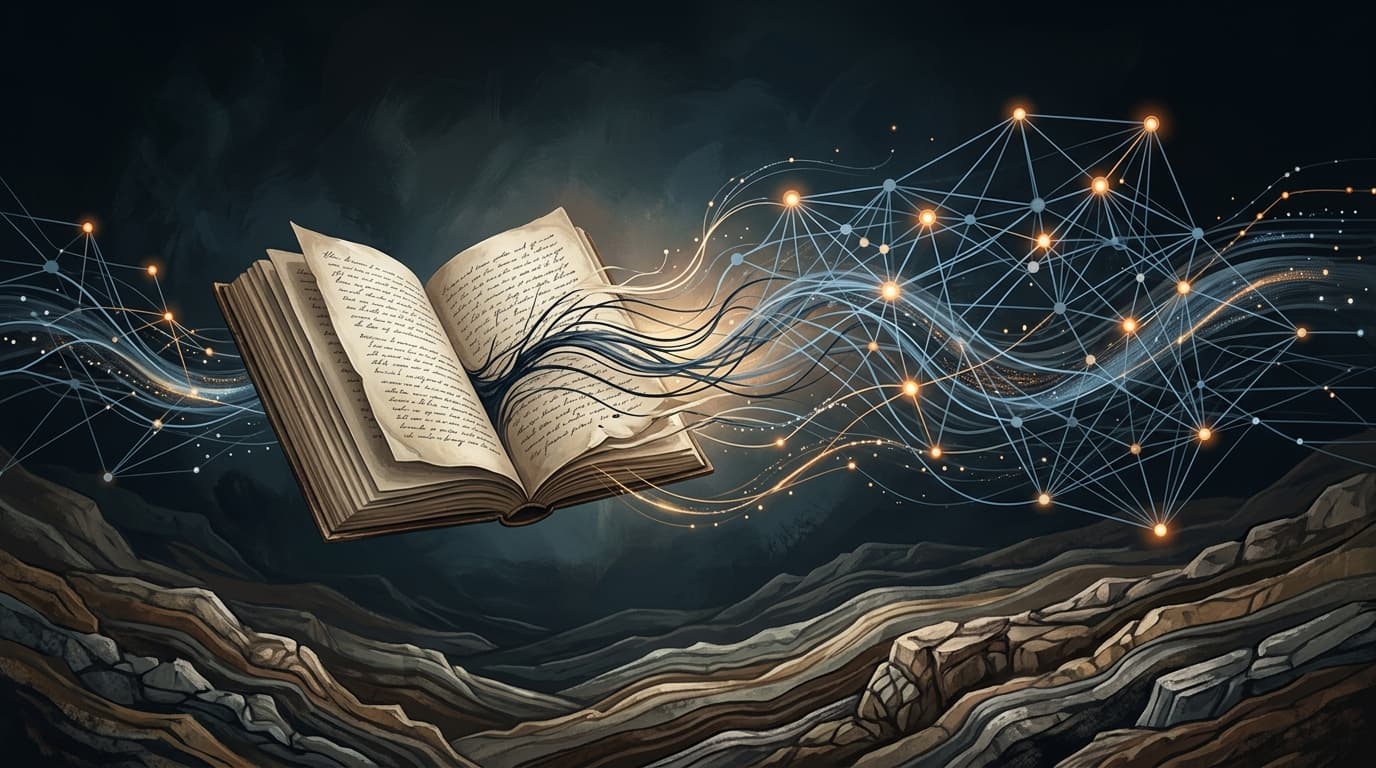
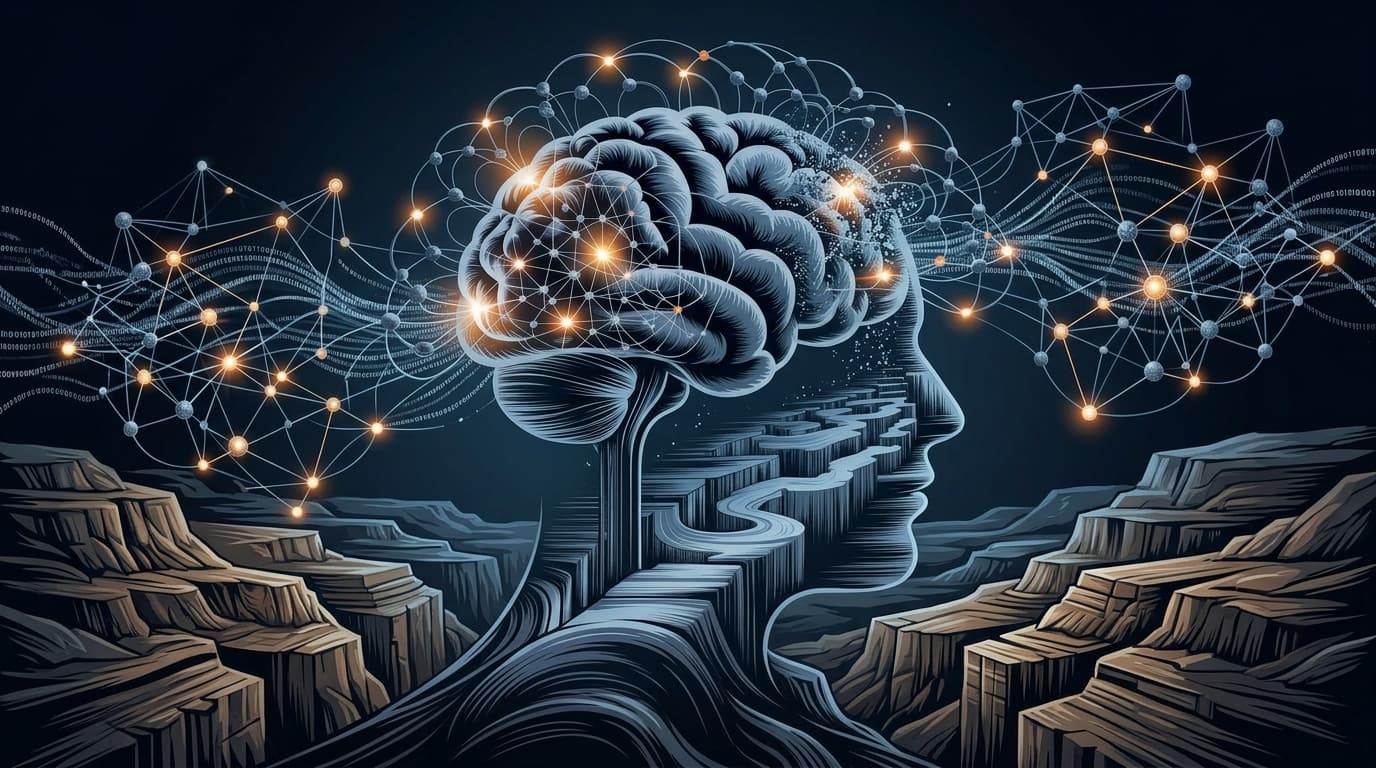

Nearly 300 mathematicians. 2,650 years of history. A living graph of connections among the minds that shaped our understanding of the world.
The Idea That Wouldn’t Go Away
There are projects born of a flash. NexusMathematica was born of an obsession.
During fifteen years of teaching mathematics, the same plain truth kept asserting itself, whether anyone heard it or not: mathematics didn’t drop out of the sky. It was thought, disputed, and dreamed by men and women who wrote to one another, read one another, and sometimes hated one another. Behind every theorem students are asked to swallow whole, there is a story. A face. A lineage.
But here is the thing. When you open a school textbook, mathematics arrives already packaged. Smooth, polished, and cut off from its roots. Pythagoras, Euclid, Descartes, Newton — names floating like ghostly figures, each in its own chapter, without our ever glimpsing the invisible threads that connect them.
Yet those threads exist. They are everywhere. They are what made mathematics move forward.
The idea of NexusMathematica germinated there. In that daily frustration. And in a conviction that sharpened over the years: mathematics is not told along a timeline. It is mapped as a network.
Mathematics is not told along a timeline. It is mapped as a network.
Why a Graph, Not a Timeline
Timelines are a fine pedagogical invention. But they lie a little.
They line up names like pearls on a string, from left to right, and lead us to believe that one discovery mechanically follows another. Yet the history of mathematics looks far less like a parade than a spiderweb. Fermat speaks with Pascal across three centuries without ever meeting him. Ramanujan rediscovers formulas in 1913 that Euler had sensed in 1750, without ever having heard of them. Ideas cross centuries, disappear, resurface, and fertilize disciplines we thought were sealed off from one another.
A graph tells that story. It follows the true shape of thought.
That is why NexusMathematica is not a catalog — even a beautifully presented one — but a networked database built on Neo4j. Each mathematician is a node. Each relationship between two minds — master and student, adversary and adversary, predecessor and successor — is an edge. The visitor does not read an encyclopedia. They wander through it. They click on Gauss and discover to whom Gauss was indebted, whom Gauss trained, and with whom Gauss quarreled. They can begin with al-Khwarizmi and work their way up to today’s language models without ever losing the thread of reasoning.
Nearly 300 mathematicians. 2,650 years of history. One fabric.
A graph does tell that story. It hugs the true shape of thought.
What NexusMathematica Is Not
Let us be clear, because a project like this one draws misunderstandings the way honey draws wasps.
It is not an encyclopedia — Wikipedia does that very well, and we have neither the ambition nor the means to compete with it. It is not an educational tool in the schoolroom sense — no photocopiable sheets, no answer keys. Nor is it a showcase of mathematical knowledge — formulas will be rare there, deliberately so.
NexusMathematica is something else. A mapped walk through the history of mathematical thought, built to awaken desire. The desire to read a biography you would never have opened. The desire to understand why a certain idea took two centuries to ripen. The desire to see human intelligence at work, in its triumphs as much as in its stubbornness.
The ideal reader? Someone who does not especially like mathematics but loves good stories. Or someone who already loves mathematics, but has never had the time to look at the seams.
Five AIs in the Workshop
A project of this scale, alone, is impossible. Writing 291 biographies, checking 291 bibliographies, tracing thousands of documented relationships — all of that is monastic work, except that a medieval scribe had thirty years ahead of him and the Rule of Saint Benedict to keep him on course. We have a blog, and lives outside of it.
Hence the method. NexusMathematica is being built in collaboration with five artificial intelligences, each at its post.
Claude conducts. It holds the score, structures the biographies, maintains stylistic coherence from one end of the project to the other, and watches over the voice so that it remains the same from Thales to Turing. GenSpark digs — it goes on deep research missions for each mathematician, bringing back sources, anecdotes, and controversies. Gemini fact-checks — when a fact seems doubtful, when a date looks strange, it returns to the original sources to decide. ChatGPT brings creativity to certain narrative angles. Perplexity completes the research in real time.
And in the middle of this small orchestra, a human conductor decides, validates, refuses, rewrites when the tone drifts, and chooses the connections that will make sense in the final graph.
This is not automation. It is orchestration — in the musical sense of the word. Each AI is an instrument. And as in any orchestra, the baton remains in a human hand.
This isn’t automation. It’s orchestration — in the musical sense of the word.
The State of the Work
Here is where we stand.
The first three strata — Antiquity, the Middle Ages, and the Renaissance — are being written. No premature publication: each biography goes through rigorous quality control before it goes online. Each mathematical portrait is illustrated with a carefully generated face, respecting the dress codes of its period, because a face changes everything.
The following strata — the Enlightenment, the 19th century, the 20th century, and contemporary figures — will follow. The goal is not to publish fast. The goal is to publish right.
And most importantly: everything is publicly documented. The sources for each biography, the methodological choices, the hesitations, the corrections. NexusMathematica will not be a temple you visit without understanding how it was built. It will be a cathedral you can tour with a notebook in hand. You’ll see the scaffolding as much as the vaults.
That is the NeuroStratum philosophy: we show the work in progress as much as the finished structure.
What We Hope Will Emerge
If all goes well, NexusMathematica will be accessible online as a navigable graph. You’ll click on a node, read a biography in fifteen minutes — not three academic pages, not three Wikipedia lines either — and then see whom this thinking flowed toward.
You’ll be able to begin with Hypatia of Alexandria and end with Ada Lovelace by way of Sophie Germain. You’ll be able to start from a present-day problem — a recommendation algorithm, a neural network architecture — and trace the course of ideas back to their ancient sources. You’ll be able to explore Muslim mathematicians of the 9th century without leaving your couch, and finally understand why it’s called algebra.
If a handful of readers find the spark there — the one that makes you want to pick up a book, learn a formula, or look at the world differently — then the project will have succeeded.
From Thales to AI, mathematics has never stopped weaving the world. NexusMathematica simply wants to make it visible.
From Thales to AI, mathematics has never stopped weaving the world.
The work in progress is open. Publications — first biographies, thematic arcs, methodological choices, and construction journals — appear as the work unfolds on our blog: https://neurostratum.com/index.php/blog/