
Behind the Scenes of AI: A Story of Directions and Horizons
By Jp@NeuroStratum — Originally published in French on December 1, 2025
Summary — Behind GPT, Claude, or Gemini, we imagine dizzying algorithms and billions of parameters. Yet when we gently lift the hood of these thinking machines, we find something simpler and far more beautiful: a world made of vectors, distances, and angles, where ideas aren’t stored in definitions but mapped to directions, like migrating birds seeking their way through the mathematical sky. A journey into the invisible geometry that makes modern AI think.
⏱ Estimated reading time: 5 minutes
AI may not think the way we do, but it certainly thinks in beauty.
Great ideas often hide in the most unexpected details. Take artificial intelligence. Behind GPT, Claude, or Gemini, we imagine dizzying algorithms, billions of parameters. Yet if we gently lift the hood of these thinking machines, we discover something much simpler… and more beautiful by far.
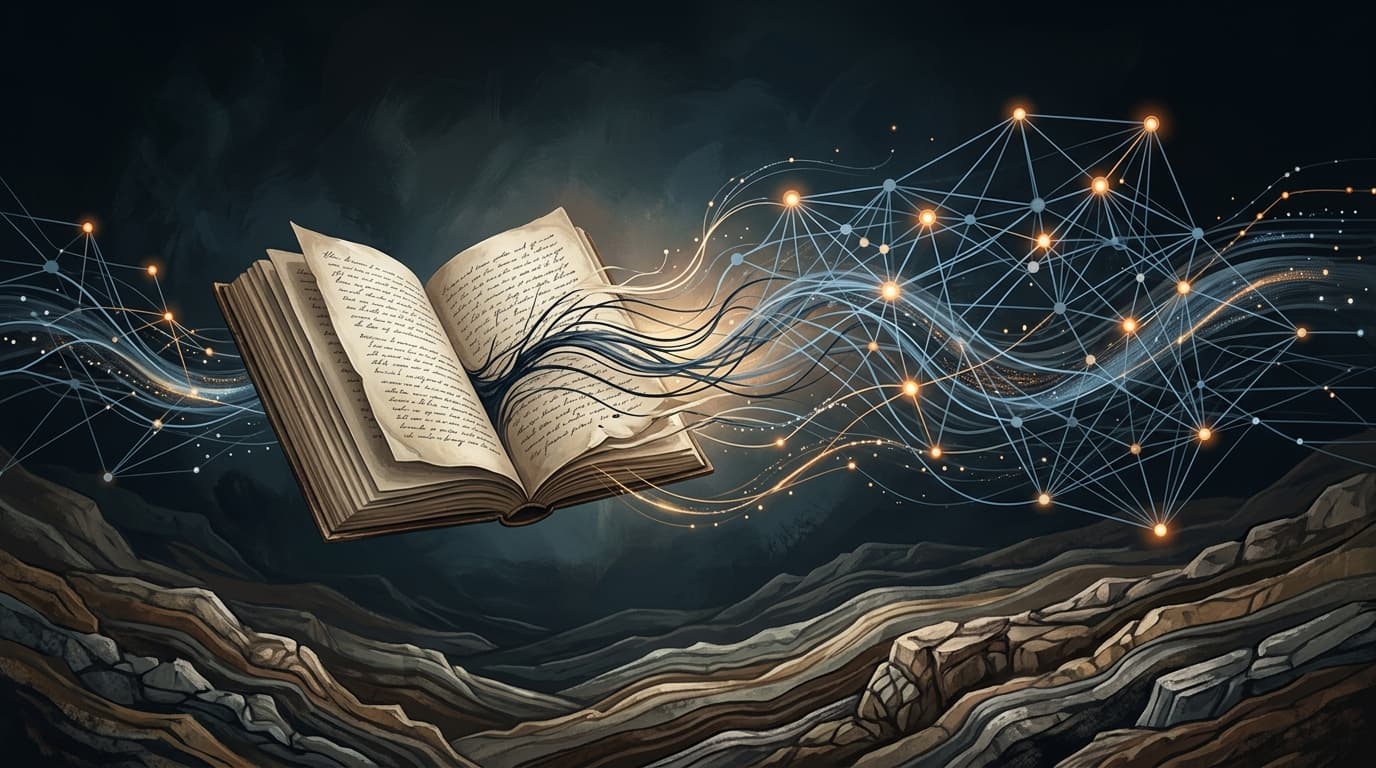
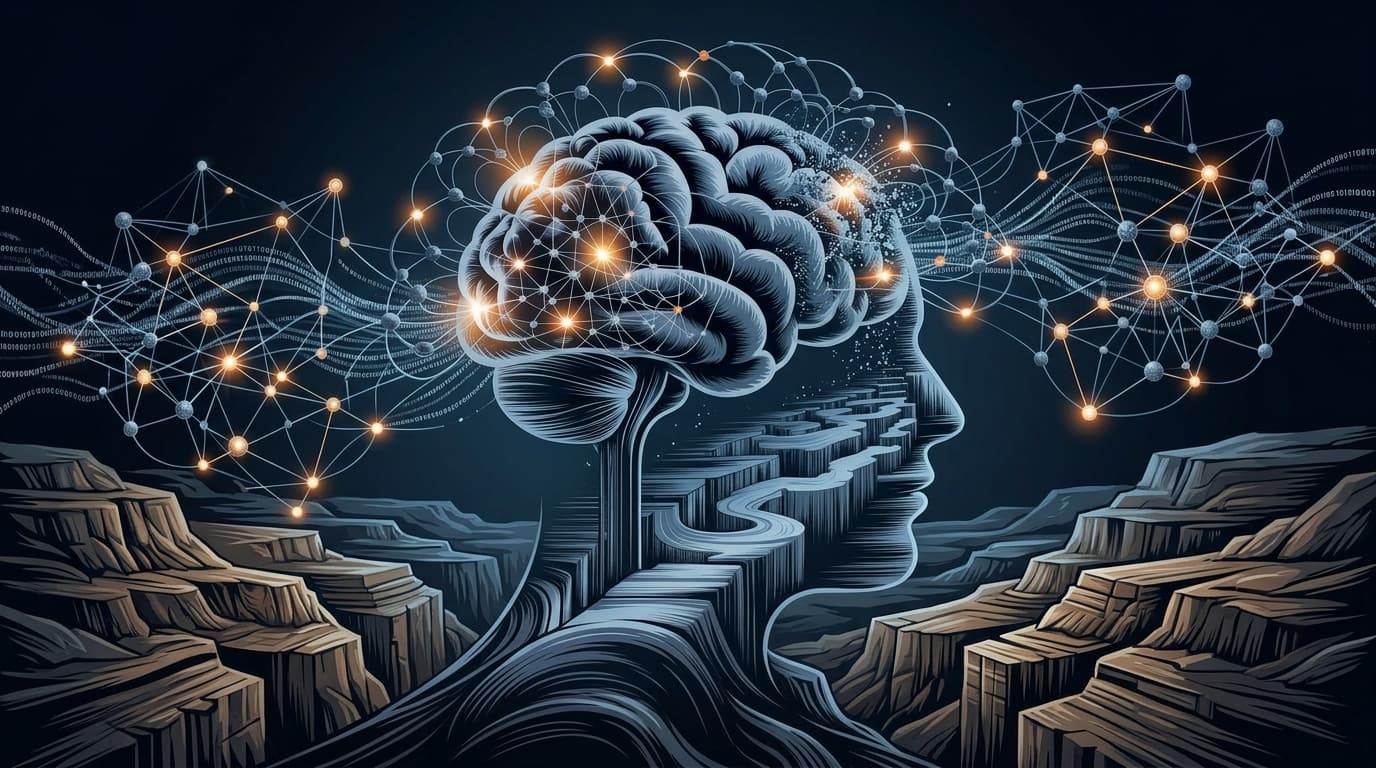
A world made of vectors, distances, and angles. A universe where ideas aren’t arranged inside dusty definitions, but mapped to directions, like migrating birds seeking their way through the mathematical sky. Modern AI thinks in geometry.
An Invisible Map of Meaning
Imagine a vast abstract terrain where each point represents a word, an image, a sentence. It’s a vector space, and despite what the name may suggest, there’s nothing terrifying about it. A vector is just an arrow indicating a direction. A distance measures the proximity between two ideas. An angle reveals a conceptual affinity.
Think of a map where « love, » « tenderness, » and « affection » form a warm neighborhood, while « violin, » « piano, » and « Baroque music » gather around a cobbled square. That is what a vector space gives us: a map of meaning.
For this map to work, we need a Hilbert space — a perfectly ordered space where even the wildest ideas know where to stand. Hilbert is the discreet architect of modern AI, the one who makes it possible to measure distances, compare angles, and organize thousands of dimensions without getting lost.
The Secret of Embeddings
An embedding is the translation of a concept into a vector. The word « castle » becomes a sequence of numbers: 0.12, -3.7, 1.8, 0.02… Hundreds of coordinates encoding its meaning, context, and relationships.
The result? AIs know that « king, » « queen, » and « crown » are close. They understand that « pain » and « fear » inhabit the same emotional neighborhood. It isn’t magic. It’s geometry. Relationships become directions: « woman → man, » « positive → negative, » « president → country. » Models learn these directions by observing language, like vectors forming swarms of ideas.
To compare two concepts, AI observes the direction in which they point — this is cosine similarity. If two vectors point toward the same horizon, the ideas are close. « Joy » and « happiness » are perfectly aligned. « War » and « peace » point in opposite directions. What matters isn’t the length of the arrow, but the horizon it indicates.
From Transformers to RAG
Modern models use linear transformations — matrices that transform one vector into another, revealing hidden relationships. In attention layers, vectors attend to one another in a geometric ballet. At its core, a matrix is a tuner: it adjusts the melody of vectors to reveal a harmony.
This geometry allows models to understand context, anticipate, and generalize. They aren’t « intelligent » in the human sense — they’re geometrically sensitive, creating the illusion of intuition.
Vector Search
If everything is a vector, information can be searched for by mathematical proximity. Vector search turns your question into a vector and retrieves the closest documents. No need for identical words, only the same direction. It’s navigating a library by feel rather than by title.
RAG: The Hybrid Intelligence
RAG (Retrieval-Augmented Generation) combines this search with generation: AI first consults the geometric library, then writes a reliable and up-to-date answer. A writer who first consults their sources, then lets the pen do the rest.
The Poetry of Mathematics
Behind every sentence generated by an AI, there’s a silent dance of vectors drawing near, answering one another, and tracing a path toward meaning. Perhaps it’s in this invisible geometry, more than in the technology itself, that the deeper poetry of artificial intelligence resides.
The next time you speak with an AI, remember this hidden universe. Those migrating birds seeking their way, those vectors forming swarms of ideas, that invisible map where every concept has its place. AI may not think the way we do, but it certainly thinks in beauty.
Written with the support of AI to help organize thoughts and shape language.
Jp@NeuroStratum
For Further Reading
- Attention Is All You Need — Vaswani et al. (2017), the foundational paper that introduced the Transformer architecture and reshaped natural language processing: arxiv.org/abs/1706.03762
- Word2Vec — Mikolov et al. (2013), a pioneering paper showing how semantic relationships can be captured in vector spaces: arxiv.org/abs/1301.3781
- The Illustrated Transformer — Jay Alammar’s remarkable visual explanation of the Transformer architecture and the geometric ballet of vectors: jalammar.github.io/illustrated-transformer
- Retrieval-Augmented Generation for Knowledge-Intensive NLP — Lewis et al. (2020), a reference paper formalizing RAG and its hybrid approach: arxiv.org/abs/2005.11401
- Neural Networks, Manifolds, and Topology — Christopher Olah’s fascinating exploration of the geometry underlying neural networks: colah.github.io/posts/2014-03-NN-Manifolds-Topology
- Vector Embeddings Explained — Pinecone’s accessible guide to vector embeddings, their applications, and their role in modern AI: www.pinecone.io/learn/vector-embeddings
Originally published on Skool IA Mastery on December 1, 2025.